This content was aggregated from local dealer data and insights provided by the USA Today Network Automotive Insights team using Google Gemini and the Vehicles for Sale Near Chicago marketplace writing team.
Chicago winters can challenge even the most capable vehicles, with freezing temperatures, lake-effect snow, icy highways, and unpredictable travel conditions. For drivers considering an electric SUV, the 2026 Toyota bZ introduces an important question: can it deliver dependable everyday transportation while handling winter road trips across Illinois and the Midwest? With available all-wheel drive, improved electric driving range, faster charging capabilities, and a technology-focused interior, the 2026 Toyota bZ offers several features designed to make electric ownership more practical. Understanding how those capabilities perform in cold weather can help Chicago shoppers determine whether this electric Toyota fits their driving habits and travel expectations.
The 2026 Toyota bZ represents an important evolution of Toyota's all-electric compact SUV. Previously known as the bZ4X, the model enters 2026 with a simplified name, updated styling, revised electric powertrains, and improvements intended to address common concerns about electric vehicle ownership.
For Chicago drivers, those changes are particularly relevant. Cold-weather range, charging accessibility, winter traction, and cabin comfort are major considerations when choosing an electric vehicle in the Midwest.
The 2026 Toyota bZ offers front-wheel-drive and all-wheel-drive configurations, allowing shoppers to prioritize maximum driving range or additional traction capability.
Front-wheel-drive models emphasize efficiency and everyday affordability, while all-wheel-drive versions provide stronger acceleration and improved traction when pulling away on slippery surfaces.
The lineup includes XLE and Limited configurations, with battery and drivetrain options influencing performance, range, and equipment.
For drivers who primarily commute within the Chicago metropolitan area, an efficient front-wheel-drive bZ may provide sufficient capability. Buyers who frequently travel through snow-covered neighborhoods, suburban roads, or rural highways may find the available AWD system more appealing.
The central value proposition is that the 2026 Toyota bZ combines electric driving with the practicality of a compact SUV, while offering meaningful improvements over the previous bZ4X.
The 2026 Toyota bZ offers multiple powertrain configurations designed for different driving priorities.
The entry-level front-wheel-drive XLE uses a smaller battery and emphasizes affordability, while other configurations offer a larger battery for extended EPA-estimated driving range.
All-wheel-drive models use two electric motors to provide additional traction and stronger acceleration.
Key manufacturer-reported specifications include:
Configuration | Battery Capacity | Horsepower | EPA-Estimated Range |
XLE FWD, smaller battery | 57.7 kWh | 168 hp | Up to 236 miles |
XLE FWD, larger battery | 74.7 kWh | 221 hp | Up to 314 miles |
XLE AWD | 74.7 kWh | 338 hp | Up to 288 miles |
Limited FWD | 74.7 kWh | 221 hp | Up to 299 miles |
Limited AWD | 74.7 kWh | 338 hp | Up to 278 miles |
Range figures represent published EPA estimates for specified configurations under standardized test conditions. Actual real-world winter range varies with temperature, speed, driving habits, tires, terrain, and climate-control use.
The difference between these configurations matters for Chicago drivers.
The larger-battery FWD XLE prioritizes driving distance, making it attractive for commuters who regularly travel between the city and surrounding suburbs, though winter weather will reduce its usable driving distance below the EPA estimate.
The AWD models sacrifice some EPA-estimated range in exchange for greater power and improved acceleration traction.
With up to 338 horsepower, the AWD Toyota bZ delivers substantial performance for a compact electric SUV.
Electric motors provide immediate torque, making acceleration smooth and responsive during highway merging and urban driving.
However, winter traction depends on more than horsepower. Appropriate tires remain essential, particularly when temperatures fall below freezing.
Chicago's winter conditions make drivetrain selection an important part of the buying decision.
The available AWD system can distribute power between the front and rear axles to help maintain traction when accelerating on slippery pavement.
This can be useful when navigating snow-covered residential streets, pulling away from icy intersections, or driving on partially cleared suburban roads.
AWD models also offer Toyota's X-MODE capability, which is designed to help manage traction in challenging low-grip conditions.
However, AWD does not guarantee shorter stopping distances on ice.
Winter tires can substantially improve braking, cornering, and acceleration traction compared with tires that are not designed for cold-weather conditions.
For Chicago drivers who regularly encounter significant snowfall, an AWD bZ equipped with appropriate winter tires offers a stronger winter-driving combination than relying on AWD alone.
One of the most important improvements for the 2026 Toyota bZ is its enhanced battery thermal-management capability.
Electric vehicle batteries operate most efficiently within a suitable temperature range. In very cold weather, battery temperature can limit charging performance, particularly at DC fast chargers.
The 2026 bZ includes battery preconditioning technology intended to help bring the battery closer to an appropriate temperature before fast charging.
This is especially valuable during winter road trips, when a cold battery may otherwise accept charging power more slowly.
The bZ also adopts the North American Charging Standard (NACS) charging port, improving access to compatible charging infrastructure.
Under ideal charging conditions (such as mild ambient temperatures and a preconditioned battery), Toyota indicates that DC fast charging can replenish the battery from approximately 10% to 80% in around 30 minutes.
Actual charging times depend on battery temperature, state of charge, charger capability, and other operating conditions.
During a Chicago winter, drivers should allow additional charging time and avoid assuming every fast-charging stop will match ideal manufacturer estimates.
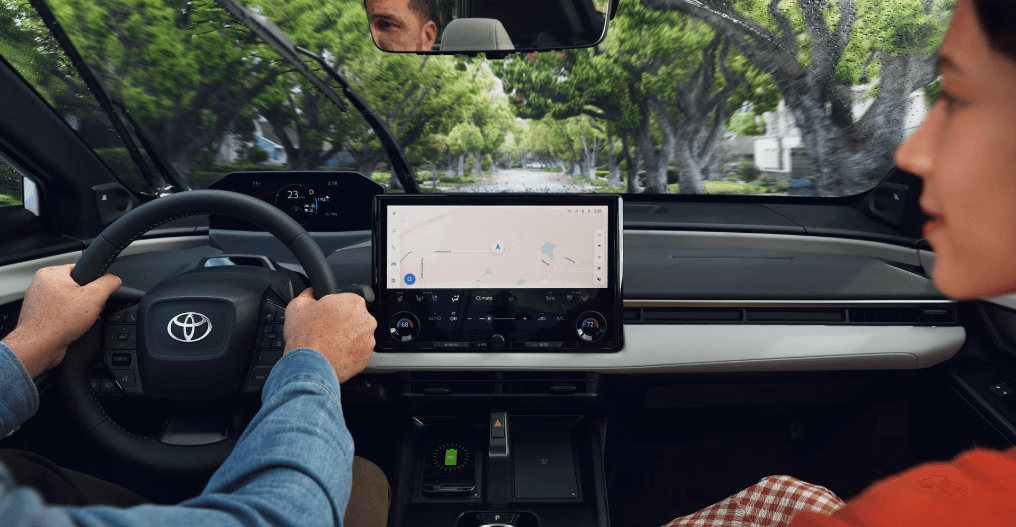
The 2026 Toyota bZ features a modern cabin designed around digital connectivity and everyday convenience.
A 14-inch Toyota Audio Multimedia touchscreen serves as the primary infotainment interface.
Wireless Apple CarPlay and Android Auto compatibility allow drivers to connect supported smartphones for navigation, music, and communication.
The cabin also includes convenient storage solutions and a practical seating layout for everyday transportation.
Available features vary by trim and may include upgraded seating materials, enhanced comfort equipment, and additional convenience technologies.
For winter driving, heated seating surfaces and a heated steering wheel can make cold-weather commuting more comfortable.
These features can also help drivers manage cabin comfort efficiently, although total energy consumption still depends on outside temperature and climate-control settings.
The 2026 Toyota bZ includes Toyota Safety Sense 3.0, a suite of active-safety and driver-assistance technologies.
Depending on equipment and operating conditions, the system includes features such as:
Pre-Collision System with Pedestrian Detection
Full-Speed Range Dynamic Radar Cruise Control
Lane Departure Alert with Steering Assist
Lane Tracing Assist
Road Sign Assist
Automatic High Beams
Proactive Driving Assist
These systems can provide valuable support during highway travel and routine commuting.
However, snow, ice, road salt, and poor visibility may affect cameras and sensors.
Chicago drivers should keep relevant sensors clear and remain attentive during severe weather.
Driver-assistance systems cannot replace careful speed management, adequate following distance, or appropriate winter tires.
Choosing the right 2026 Toyota bZ configuration involves balancing three priorities: driving range, winter traction, and comfort features.
For Chicago shoppers, the longest-range model is not automatically the best choice, just as the most powerful AWD version is not necessary for every driver.
Understanding the differences between configurations helps buyers avoid paying for features they may rarely use.
Configuration | Main Advantage | Consideration | Best Fit |
XLE FWD, smaller battery | Lower expected entry cost | Shorter driving range | Urban commuters with dependable charging |
XLE FWD, larger battery | Maximum EPA-estimated driving range | No AWD traction advantage | Frequent suburban and highway commuters |
XLE AWD | Strong acceleration and winter traction | Lower EPA-estimated range than comparable FWD | Drivers regularly encountering snow |
Limited FWD | Premium comfort and efficiency | Higher equipment cost | Comfort-focused commuters |
Limited AWD | Premium features and AWD performance | Higher expected cost and reduced EPA-estimated range | Buyers prioritizing equipment and winter capability |
The XLE FWD provides an accessible introduction to Toyota's electric SUV lineup.
For drivers who primarily travel within Chicago, Elmhurst, Oak Brook, or nearby communities, the smaller-battery version may provide sufficient range for routine commuting and errands.
However, buyers who regularly travel longer distances should carefully consider the larger-battery FWD configuration.
Its higher estimated range creates additional flexibility, especially when cold temperatures reduce real-world efficiency.
For drivers with dependable home charging, the larger-battery FWD model may represent one of the most practical combinations of range and everyday usability.
The XLE AWD offers a different value proposition.
Its dual-motor powertrain produces 338 horsepower and adds traction capability for slippery conditions.
This makes it appealing for Chicago-area drivers who regularly encounter snow-covered roads or travel beyond heavily maintained urban routes.
The trade-off is reduced EPA-estimated driving range compared with the longest-range FWD configuration.
Buyers should consider whether the additional traction and acceleration are worth that compromise.
For drivers who frequently travel through winter weather, AWD may provide meaningful everyday benefits.
The Limited configurations emphasize additional comfort, technology, and convenience equipment.
The Limited FWD maintains the efficiency-oriented character of the single-motor powertrain, while the Limited AWD combines premium equipment with the stronger dual-motor system.
For drivers who spend considerable time commuting, comfort features can be worthwhile.
However, the additional equipment does not necessarily improve cold-weather range or charging speed.
Buyers focused primarily on road-trip capability may find that battery capacity, drivetrain, and charging access matter more than luxury-oriented upgrades.
The purchase price is only one part of the cost of owning an electric vehicle.
Chicago shoppers should also consider home charging installation, electricity rates, public charging costs, insurance, tire replacement, and long-term battery warranty coverage.
Electric vehicles generally require fewer routine engine-related maintenance services than gasoline-powered vehicles because they do not need engine oil changes, spark plugs, or conventional exhaust-system maintenance.
However, tires, brakes, suspension components, cabin filters, and other systems still require attention.
AWD configurations may also carry higher tire and energy costs depending on driving habits and equipment.
Rather than focusing solely on the lowest purchase price, buyers should evaluate which configuration provides the best combination of usable range, charging convenience, and winter capability for their lifestyle.
The 2026 Toyota bZ is well suited to the stop-and-go driving common throughout the Chicago metropolitan area.
Electric motors deliver smooth acceleration without conventional gear changes, making daily commuting feel responsive and refined.
For drivers traveling along I-290, I-294, I-90, or I-88, the bZ provides the highway capability expected from a modern compact SUV.
Its elevated seating position and practical cabin also make it suitable for commuting, shopping, and family transportation.
Drivers who can charge at home may find electric ownership particularly convenient.
Instead of visiting a gasoline station, they can begin many mornings with a battery charged to their preferred level.
For commuters whose daily mileage is relatively predictable, this can make the bZ easy to integrate into an established routine.
Cold weather is one of the most important considerations for electric vehicle ownership in Illinois.
Battery chemistry, cabin heating, tire resistance, and road conditions can all reduce driving range.
At freezing temperatures, the bZ will travel significantly fewer miles per charge than its published EPA-estimated range suggests.
The reduction varies depending on temperature, trip length, driving speed, climate-control use, and battery temperature.
Short winter trips can be particularly inefficient because the vehicle may repeatedly use energy to warm the cabin and battery.
Highway driving at sustained speeds can also increase energy consumption.
Chicago drivers should therefore avoid treating the maximum advertised EPA-estimated range as a guaranteed winter driving distance.
For longer journeys, building additional charging stops into the route provides a useful safety margin.
The 2026 Toyota bZ can support regional road trips, but winter travel requires more planning than a comparable gasoline-powered SUV.
Consider a trip from Chicago toward Milwaukee, Rockford, Madison, or destinations farther into Wisconsin and Illinois.
Before departure, drivers should check the vehicle's battery charge, expected weather conditions, and available charging stations along the route.
Cold temperatures and highway speeds can reduce range, making charging-stop selection especially important.
Using compatible DC fast chargers can help reduce downtime, while battery preconditioning may improve charging performance when conditions allow.
Drivers should also identify backup charging locations in case a preferred station is unavailable or operating below its expected power output.
For longer winter trips, the larger-battery configurations provide more flexibility than the entry-level smaller-battery version.
The AWD models add traction benefits, but their lower EPA-estimated range means drivers should plan accordingly for winter conditions.
Home charging is one of the most important factors in determining whether the bZ is a good fit for a Chicago household.
A Level 2 home charger can replenish the battery overnight or during extended parking periods, depending on battery capacity, charging equipment, and the vehicle's onboard charging capability.
For drivers with a private driveway or garage, this arrangement can make everyday EV ownership relatively straightforward.
Apartment residents and drivers without dedicated parking may rely more heavily on public charging infrastructure.
That can introduce additional planning, especially during winter when charging sessions may take longer.
Public DC fast charging is best viewed as a useful tool for longer journeys rather than the only charging method for every owner.
Buyers should investigate charging availability near home, work, and frequently visited destinations before choosing an electric vehicle.
Although electric vehicles eliminate many gasoline-engine maintenance tasks, winter preparation remains essential.
Tire selection is particularly important.
The bZ's available AWD system can improve acceleration traction, but winter tires may provide substantial benefits when braking or turning on snow and ice.
Drivers should also monitor tire pressure as temperatures fall.
Road salt and winter grime make regular cleaning worthwhile, including appropriate underbody washing.
Charging equipment and connectors should be kept clean and protected from snow and ice according to manufacturer guidance.
For extended winter trips, carrying emergency supplies, warm clothing, and a charging contingency plan is sensible.
The bZ can be a practical year-round vehicle, but successful winter ownership depends on realistic expectations and preparation.
The 2026 Toyota bZ offers several features that support winter driving, including available AWD, battery preconditioning, and modern traction-control technology. AWD models may provide improved acceleration traction on snow-covered roads. However, cold temperatures can reduce electric driving range, and winter tires remain important for braking and cornering performance.
Cold-weather range loss depends on temperature, driving speed, cabin heating, battery temperature, and road conditions. There is no single percentage that applies to every winter trip. Chicago drivers should expect less range than ideal-condition estimates during freezing weather and plan additional charging time and reserve capacity for longer journeys.
Yes, the 2026 Toyota bZ can be suitable for a Chicago-to-Milwaukee road trip, particularly when drivers begin with sufficient charge and account for cold-weather efficiency losses. The trip is approximately 90 miles each way, depending on the route. Charging availability, battery configuration, weather conditions, and the planned return journey should all be considered.
AWD may be worth the additional expense for drivers who frequently encounter snowy streets, slippery inclines, or less-maintained winter roads. FWD models generally provide greater EPA-estimated range and may offer better purchase value. For drivers primarily using cleared highways and city streets, FWD with appropriate tires may be entirely sufficient.
Under ideal charging conditions, the 2026 Toyota bZ can charge from approximately 10% to 80% in around 30 minutes using compatible DC fast-charging equipment. In freezing weather, charging may take longer because battery temperature affects charging performance. Battery preconditioning can help, but drivers should allow extra time when planning winter road trips.
The 2026 Toyota bZ offers meaningful improvements that make it a stronger candidate for electric vehicle ownership in Chicago.
Its available AWD system provides additional traction capability, while larger-battery configurations offer driving ranges suitable for many everyday commuting and regional travel needs.
The adoption of NACS charging, improved battery thermal management, and modern connectivity features also helps address practical concerns associated with electric road trips.
However, Chicago winters still present challenges.
Cold temperatures can reduce range, public charging may take longer than expected, and winter road conditions require appropriate tires and careful driving.
For drivers with dependable home charging and predictable commuting patterns, the bZ can be a practical electric SUV.
For frequent winter road-trippers, the larger-battery configurations are especially appealing, while AWD deserves consideration when additional traction is a priority.
The 2026 Toyota bZ is capable of fitting into a Chicago driver's winter travel routine, but its strongest value comes when buyers select the right battery, drivetrain, and charging setup for their actual needs.
Choosing the right electric SUV starts with comparing driving range, drivetrain capability, charging features, and interior equipment.
Browse 2026 Toyota bZ for sale near Chicago to explore current listings, compare configurations, and review individual vehicle specifications.
You can also learn more about McGrath Elmhurst Toyota to review dealership information and explore your options before taking the next step.
Written for https://vehiclesforsalenearchicago.com/
By the USA TODAY Network Automotive Insights Team, in collaboration with McGrath Elmhurst Toyota and the Vehicles For Sale Near Chicago - USA Today.
Disclaimer: This article's content is intended for informational purposes only. Vehicle specifications and features are based on data provided by J.D. Power and local dealerships and may vary by individual vehicle, VIN, trim, configuration, packages, and optional equipment. Vehicle images may not depict the exact model, trim, features, packages, accessories, or specifications described. Vehicle pricing, availability, features, and specifications are subject to change without notice. Please reference the dealership's vehicle listing and window sticker or consult the dealership directly for complete and accurate details.