
This content was aggregated from local dealer data and insights provided by the USA Today Network Automotive Insights team using Google Gemini and the Vehicles for Sale Near Chicago marketplace writing team.
Between congested expressways, unpredictable winter weather, and rising transportation expenses, commuting around Chicago can put a strain on both drivers and their budgets. The 2027 Toyota Prius offers an appealing alternative for motorists considering a switch from a conventional gasoline-powered vehicle to a fuel-efficient hybrid. With its aerodynamic design, advanced hybrid technology, and practical hatchback configuration, the Prius is built around the kind of everyday efficiency that matters during long commutes. But does switching to a hybrid deliver enough value to justify the investment, and which Prius configuration makes the most sense for Chicago-area drivers?
The Toyota Prius has long been associated with hybrid efficiency, but its modern design offers more than impressive fuel economy. The latest Prius generation combines a responsive gasoline-electric powertrain, distinctive styling, modern connectivity, and a versatile hatchback layout.
For Chicago commuters, the central appeal is the ability to reduce fuel consumption without changing the familiar experience of owning and driving a gasoline-powered vehicle.
Unlike a fully electric vehicle, the standard Prius hybrid does not require external charging. Its battery is replenished through regenerative braking and energy generated by the gasoline engine. Drivers can refuel at conventional gas stations while benefiting from electric-motor assistance during acceleration and low-speed driving.
This makes the Prius particularly appealing to motorists who live in apartments, use shared parking facilities, or lack access to dedicated home charging.
The recent Prius lineup has included LE, XLE, and Limited configurations, each offering a different balance of affordability, comfort, and technology. Toyota has also offered front-wheel-drive and available all-wheel-drive versions, allowing shoppers to consider winter traction alongside efficiency.
Official Toyota information published on July 16, 2026, confirms the specifications and trim lineup for the 2027 model year. The comparisons below reflect these official details.
The biggest reason to consider the Prius is its ability to reduce fuel consumption during everyday driving.
Conventional gasoline vehicles rely entirely on their engines for propulsion, while the Prius combines a gasoline engine with electric motors and a hybrid battery.
During city driving, the hybrid system can use electric assistance and recover energy through regenerative braking. This is particularly useful in stop-and-go traffic, where conventional vehicles frequently consume fuel while accelerating and lose energy through braking.
For drivers commuting along I-90, I-94, I-290, or the Eisenhower and Kennedy expressways, the Prius can make efficient use of driving conditions that often challenge conventional gasoline vehicles.
However, the value of switching depends on annual mileage, current vehicle efficiency, purchase costs, and how long the owner plans to keep the car.
A driver replacing a relatively inefficient older vehicle may see meaningful fuel savings. Someone already driving a highly efficient compact car may experience a smaller financial benefit.
The fifth-generation Toyota Prius uses a 2.0-liter four-cylinder gasoline engine paired with an electric hybrid system.
Recent front-wheel-drive Prius models produce approximately 194 combined horsepower, while available all-wheel-drive versions produce approximately 196 combined horsepower.
This represents a substantial improvement over earlier Prius generations and gives the vehicle enough power for everyday highway travel, passing, and merging.
The electronically controlled continuously variable transmission (eCVT) helps deliver smooth acceleration without conventional stepped gear changes.
For Chicago drivers, this combination is especially useful when transitioning between slow-moving downtown traffic and faster expressway travel.
Specification | Recent Fifth-Generation Prius Reference |
Powertrain | 2.0L four-cylinder gasoline-electric hybrid |
Combined horsepower | Approximately 194 hp FWD / 196 hp AWD |
Transmission | Electronically controlled CVT |
Drivetrain | Front-wheel drive; available all-wheel drive |
Seating capacity | Five |
Body style | Five-door hatchback |
Battery | Lithium-ion hybrid battery |
External charging required | No |
Fuel economy | Up to 55 mpg combined for LE FWD |
Cargo capacity | Approximately 20.3–23.8 cubic feet behind rear seats, depending on configuration |
These figures reflect official specifications confirmed by Toyota on July 16, 2026.
Fuel efficiency remains the Prius's defining advantage.
The 2027 Toyota Prius LE FWD achieves an official EPA-estimated 55 mpg combined, although ratings vary by trim and drivetrain.
For commuters covering significant distances across the Chicago metropolitan area, that level of efficiency can translate into fewer gas station visits and potentially lower annual fuel expenses.
The benefit is particularly relevant in urban traffic because the hybrid system can recover some braking energy and use electric assistance when appropriate.
However, drivers should not expect the EPA rating in every situation.
Cold temperatures, winter tires, cabin heating, short trips, highway speeds, and aggressive acceleration can all affect actual fuel economy.
Chicago's winter weather can reduce hybrid efficiency, particularly when the gasoline engine must run more frequently to provide cabin heat or maintain operating temperature.
Even with seasonal variations, the Prius remains designed around minimizing fuel consumption during routine driving.
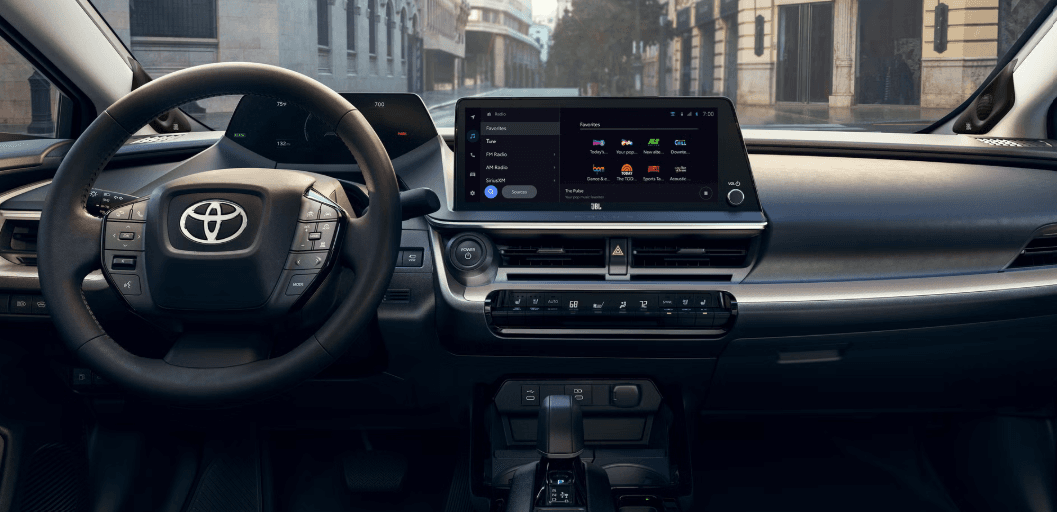
The modern Prius interior emphasizes digital convenience and straightforward access to essential driving information.
Depending on trim and equipment, recent models offer features such as:
An 8-inch Toyota Audio Multimedia touchscreen
An available 12.3-inch multimedia display
Wireless Apple CarPlay and Android Auto compatibility
Digital driver information displays
Available wireless smartphone charging
Dual-zone automatic climate control
Available heated front seats and heated steering wheel
Available premium audio equipment
For Chicago commuters, smartphone integration can be particularly useful when checking traffic conditions, accessing navigation applications, or managing entertainment during lengthy drives.
The larger available multimedia display may appeal to drivers who regularly use navigation, while the standard touchscreen can meet the needs of shoppers prioritizing value.
Buyers should confirm the final 2027 trim-specific equipment before comparing vehicles.
Safety technology is another important part of the Prius's commuter-oriented appeal.
Recent Prius models include Toyota Safety Sense 3.0, a collection of driver-assistance technologies designed to support attentive driving.
Features include:
Pre-Collision System with Pedestrian Detection
Full-Speed Range Dynamic Radar Cruise Control
Lane Departure Alert with Steering Assist
Lane Tracing Assist
Road Sign Assist
Automatic High Beams
Proactive Driving Assist
These technologies can be especially helpful during routine highway commuting and heavy traffic.
Adaptive cruise control can assist with maintaining a selected following distance, while lane-related systems provide additional support on clearly marked roads.
However, snow, ice, heavy rain, and obstructed sensors may limit system performance. Drivers must remain responsible for steering, braking, and maintaining safe speeds.
The Prius's hatchback design adds versatility beyond fuel efficiency.
Unlike a traditional sedan, the Prius provides a rear liftgate that opens to a cargo area suitable for groceries, luggage, work equipment, and other everyday belongings.
Folding the rear seats expands carrying flexibility when additional space is needed.
This can be useful for Chicago residents who want one vehicle to handle weekday commuting, shopping trips, and occasional weekend travel.
The Prius's low roofline and aerodynamic styling do create compromises. Rear headroom and outward visibility may feel more restricted than in a conventional compact SUV.
For buyers who rarely carry large passengers or bulky cargo, however, the hatchback layout offers a useful balance between compact exterior dimensions and everyday utility.
Choosing the right Prius configuration is essential to getting the most value from a hybrid purchase.
Although the Prius lineup emphasizes efficiency across its configurations, trim levels differ in comfort, technology, convenience features, and wheel sizes.
The lineup includes LE, XLE, Limited, and Nightshade configurations, offering options tailored to various driver preferences.
Configuration | Primary Advantages | Value Proposition | Best Fit | ||||
LE FWD | Efficiency-focused equipment and smaller wheels | Strongest emphasis on affordability and fuel savings | Budget-conscious commuters | ||||
LE AWD | Efficiency with additional traction capability | Practical choice for drivers concerned about winter conditions | Year-round Chicago commuters | ||||
XLE | Additional comfort and convenience features | Balance of efficiency and premium amenities | Drivers with longer commutes | ||||
Limited
| Higher-level technology and interior features | Most upscale ownership experience | Buyers prioritizing comfort and convenience |
The LE has traditionally been the most affordable entry point into the standard Prius hybrid lineup.
It emphasizes the features most closely associated with the Prius: efficient transportation, modern safety technology, and practical everyday usability.
Smaller wheels and less luxury-oriented equipment can also contribute to the LE's efficiency advantage over higher trims.
For a Chicago commuter whose main objective is reducing gasoline consumption, the LE deserves serious consideration.
Buyers who prioritize operating costs over premium amenities may find that the LE delivers nearly everything they need.
The XLE builds on the LE's core hybrid platform with additional comfort and convenience equipment.
Recent XLE models have included upgrades such as heated front seats, SofTex-trimmed seating surfaces, and additional convenience features.
For Chicago drivers who spend substantial time commuting, these amenities can make a meaningful difference.
Heated seats are particularly useful during winter, while upgraded interior materials may improve the overall ownership experience.
The trade-off is that higher-trim equipment and larger wheels can affect purchase costs and fuel economy.
The XLE is most attractive when drivers value additional comfort enough to justify those differences.
The Limited has traditionally represented the most fully equipped version of the standard Prius hybrid.
Recent Limited models offer additional technology, upgraded audio, and convenience features that create a more premium driving environment.
For commuters who spend an hour or more in their vehicles each day, these features may be worthwhile.
However, buyers should recognize that the Limited's higher equipment level does not necessarily produce better fuel efficiency.
The additional expense primarily buys convenience and refinement rather than a fundamental improvement in the hybrid system.
The Nightshade grade brings a bolder look to the Prius lineup with dark exterior badging, black wheels, and unique design cues.
It combines the efficiency and technology of the core trims with a sportier, customized visual presence for drivers looking to stand out on Chicago streets.
Available all-wheel drive is an important consideration for Chicago-area drivers.
The Prius AWD system uses an additional electric motor to provide rear-wheel assistance when needed.
This can improve traction during acceleration on slippery surfaces, such as snow-covered streets or icy parking areas.
However, AWD does not automatically improve braking distances or cornering grip.
Proper winter tires can make a substantial difference in overall traction, regardless of drivetrain.
For drivers who primarily travel on cleared expressways and city streets, FWD may offer the strongest combination of efficiency and value.
Those who frequently encounter unplowed roads, suburban side streets, or challenging winter conditions may find AWD worth the additional expense.
Fuel savings depend on the efficiency of the vehicle being replaced.
Consider a hypothetical Chicago commuter driving 15,000 miles annually.
Illustrative annual fuel costs at $3.50 per gallon, not official 2027 EPA ratings or a current local fuel-price quote.
Vehicle Efficiency | Annual Fuel Use | Annual Fuel Cost |
Conventional vehicle averaging 25 mpg | 600 gallons | $2,100 |
Efficient gasoline vehicle averaging 35 mpg | 429 gallons | $1,500 |
Hybrid averaging 55 mpg | 273 gallons | $955 |
In this example, switching from a 25-mpg vehicle to a 55-mpg hybrid would save approximately $1,145 annually in gasoline costs.
Over five years, that could represent approximately $5,725 in fuel savings, assuming consistent mileage, fuel prices, and efficiency.
The calculation illustrates why the Prius can be financially appealing to high-mileage commuters.
However, fuel savings alone do not determine whether replacing an existing vehicle makes financial sense.
A complete comparison should also include:
Purchase price and financing costs
Taxes, registration, and insurance
Maintenance and tire expenses
Expected resale value
The value and remaining useful life of the current vehicle
For someone replacing an aging, inefficient vehicle, the Prius may offer a compelling long-term value proposition.
For someone who already owns a reliable, efficient car, keeping the existing vehicle may remain the less expensive option.
Chicago's road network presents a mixture of expressway congestion, dense urban traffic, and suburban commuting.
Routes such as I-90, I-94, I-290, and I-294 frequently involve changing traffic speeds and extended periods of slow movement.
These conditions highlight the advantages of hybrid technology.
The Prius can use electric-motor assistance during acceleration and recover energy through regenerative braking when slowing down.
Its electronically controlled transmission also provides smooth operation without the gear changes associated with a conventional stepped automatic.
For commuters traveling between Elmhurst, downtown Chicago, Oak Brook, Schaumburg, and other surrounding communities, this combination can make everyday driving feel efficient and manageable.
Cold weather is an important consideration for Prius ownership in Illinois.
Hybrid vehicles can experience reduced fuel economy during winter because batteries operate differently in low temperatures and gasoline engines may run more frequently to provide cabin heat.
Short trips can be particularly inefficient because the engine and passenger compartment may not reach optimal operating temperatures.
Winter tires, proper tire pressure, and regular maintenance can help support safe and efficient operation.
Drivers should also consider the Prius's relatively low ground clearance.
Although the car can handle normal paved-road driving, deep snow and poorly cleared streets may present challenges compared with taller crossovers.
For commuters who frequently encounter severe winter conditions, the available AWD configuration may provide additional traction during acceleration.
However, appropriate tires and careful driving remain more important than drivetrain choice alone.
The Prius's compact footprint is particularly useful in Chicago's dense urban environment.
Compared with larger SUVs, the Prius is easier to accommodate in many parking garages, residential parking areas, and crowded shopping districts.
Its aerodynamic body shape and relatively low seating position also contribute to efficient highway travel.
However, the sloping roofline can limit rearward visibility and rear-seat headroom.
Buyers should evaluate seating comfort, entry and exit, and visibility during a test drive.
For commuters who typically travel alone or with one passenger, these compromises may be relatively minor.
The Prius is not limited to city commuting.
Its fuel efficiency and hatchback cargo space make it useful for longer trips throughout Illinois, Wisconsin, Indiana, and Michigan.
Drivers planning weekend travel can benefit from fewer fuel stops compared with less efficient vehicles.
The hatchback design also accommodates luggage, groceries, and recreational equipment.
For buyers who want one vehicle to serve both weekday transportation and occasional road trips, this flexibility strengthens the Prius's overall value proposition.
One common concern among first-time hybrid buyers is battery longevity.
The Prius uses a high-voltage hybrid battery designed for repeated charging and discharging during normal driving.
Unlike a plug-in hybrid or battery-electric vehicle, the standard Prius does not require owners to install home charging equipment.
Toyota has also offered substantial hybrid battery warranty coverage on recent models, including a 10-year/150,000-mile hybrid battery warranty under applicable terms.
Buyers should confirm the warranty coverage for the specific 2027 vehicle and review the manufacturer's maintenance recommendations.
Hybrid vehicles still require routine maintenance, including engine oil changes, tire service, brake inspections, and other scheduled work.
Regenerative braking may reduce the amount of friction-brake use during normal driving, but brake components still require inspection and maintenance.
For Chicago drivers, winter road salt and moisture make regular cleaning and corrosion prevention important regardless of powertrain.
The Prius can be a worthwhile choice for Chicago commuters who drive substantial annual mileage and currently own a less efficient gasoline vehicle. Its hybrid system is especially useful in stop-and-go traffic. However, the financial benefit depends on purchase costs, annual mileage, gasoline prices, and the condition of the vehicle being replaced.
The standard Toyota Prius is a self-charging gasoline-electric hybrid and does not require external charging. Its battery receives energy through regenerative braking and the gasoline engine. Drivers refuel at conventional gas stations. This makes the Prius convenient for Chicago residents who lack dedicated home charging or rely on shared residential parking.
AWD can improve acceleration traction on slippery roads by providing additional rear-wheel assistance. This may be helpful on snow-covered neighborhood streets or parking areas. However, AWD does not eliminate the risk of sliding or shorten braking distances automatically. Proper winter tires, reduced speeds, and careful driving remain essential for Chicago winter conditions.
The LE is generally the strongest starting point for shoppers prioritizing affordability and fuel efficiency. The XLE adds comfort features that may appeal to drivers with longer commutes, while the Limited emphasizes premium technology. Buyers should compare final 2027 equipment and pricing to determine whether higher-trim upgrades justify their additional cost.
Savings depend on the efficiency of the current vehicle, annual mileage, and gasoline prices. As an illustration, a driver covering 15,000 miles annually could save approximately $1,145 per year when moving from a 25-mpg vehicle to one averaging 55 mpg at $3.50 per gallon. Actual results will vary.
For Chicago commuters focused on reducing fuel consumption without giving up the convenience of gasoline-powered transportation, the Toyota Prius presents a compelling option.
Its hybrid powertrain is particularly well suited to urban congestion, while its hatchback design, modern technology, and available AWD add practical versatility.
The LE is likely to appeal most to drivers who prioritize efficiency and affordability. The XLE offers additional comfort for longer commutes, while the Limited provides a more premium experience.
However, switching to a Prius is not automatically the most economical decision for every driver.
Buyers should consider the purchase cost, annual mileage, existing vehicle efficiency, and expected ownership period before making the change.
For motorists replacing an older, less efficient vehicle, the potential fuel savings can be meaningful over several years.
The strongest argument for the Prius is that it allows drivers to reduce everyday fuel consumption without requiring major changes to their commuting habits.
That combination of efficiency, convenience, and practicality makes the Prius a strong candidate for Chicago-area drivers evaluating their next vehicle.
If you're considering switching to a hybrid, comparing Prius configurations can help determine which combination of fuel efficiency, comfort, and winter-driving capability best matches your needs.
Browse 2027 Toyota Prius for sale near Chicago to explore current listings, compare available configurations, and review individual vehicle specifications.
You can also learn more about McGrath Elmhurst Toyota to review dealership information and explore your vehicle-shopping options.
Whether your priority is lowering commuting costs, finding a comfortable daily driver, or gaining the flexibility of a fuel-efficient hatchback, understanding the Prius lineup is an important first step toward making a well-informed purchase.
Written for https://vehiclesforsalenearchicago.com/
By the USA TODAY Network Automotive Insights Team, in collaboration with McGrath Elmhurst Toyota and the Vehicles For Sale Near Chicago - USA Today.
Disclaimer: This article's content is intended for informational purposes only. Vehicle specifications and features are based on data provided by J.D. Power and local dealerships and may vary by individual vehicle, VIN, trim, configuration, packages, and optional equipment. Vehicle images may not depict the exact model, trim, features, packages, accessories, or specifications described. Vehicle pricing, availability, features, and specifications are subject to change without notice. Please reference the dealership's vehicle listing and window sticker or consult the dealership directly for complete and accurate details.